


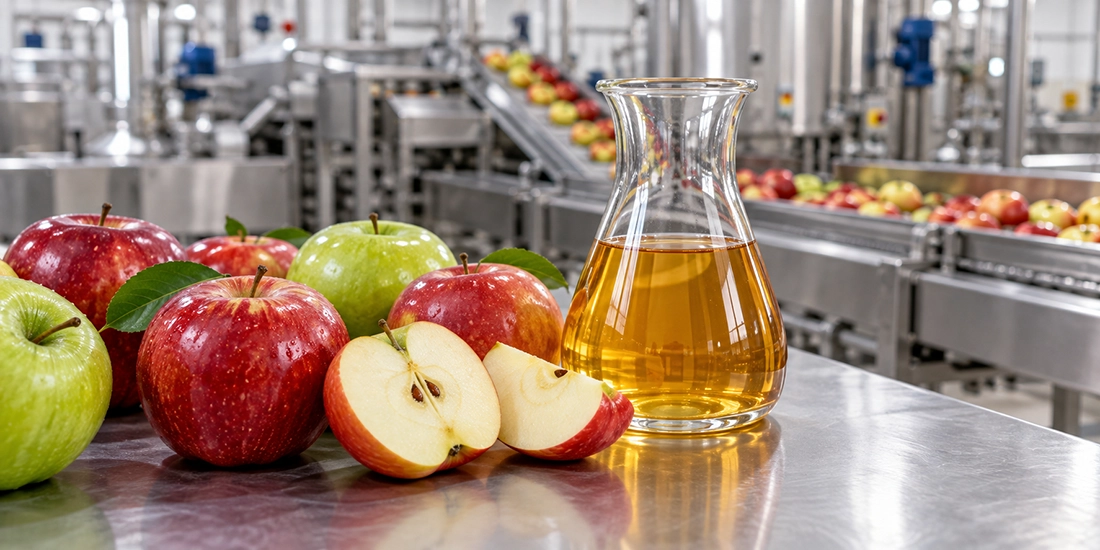
Apple Juice Concentrate in Food Production
Apple juice concentrate is one of the commonly used fruit ingredients in the food and beverage manufacturing industry. Produced by reducing the water content of apple juice, it provides manufacturers with a concentrated source of apple flavor, naturally occurring sugars, and soluble solids. Its versatility makes it suitable for a wide range of industrial applications.
How Is Apple Juice Concentrate Produced?
The production process begins with selecting and washing suitable apples. The fruit is then crushed and pressed to extract juice, which may undergo clarification and filtration depending on the desired final product.
The extracted juice is concentrated through controlled evaporation, often under reduced pressure, to remove water at relatively low temperatures.
This process produces a concentrated ingredient that occupies less volume than regular apple juice and can be reconstituted or incorporated into various formulations.
Applications in Beverage Manufacturing
Apple juice concentrate is widely used in fruit beverages, juice blends, and flavored drinks.
Because apples have a familiar and relatively versatile flavor profile, their concentrate can be combined with ingredients such as grape, pomegranate, and sour cherry concentrates.
Manufacturers use apple concentrate to adjust sweetness, soluble solids content, and overall flavor balance. However, its contribution depends on the formulation and the concentration level selected.
Uses in the Food Industry
Apple concentrate also plays an important role in several food applications.
It can be incorporated into fruit fillings, bakery products, jams, fruit preparations, and selected confectionery formulations.
In certain recipes, apple juice concentrate is used as a fruit-derived sweetening ingredient, although it still contributes sugars and should not automatically be considered a low-sugar alternative.
Its suitability depends on flavor requirements, product texture, and processing conditions.
Benefits for Manufacturers
One of the major advantages of apple juice concentrate is the reduction in transportation and storage volume compared with single-strength juice.
Manufacturers can also standardize formulations by selecting concentrates with defined Brix levels and other technical specifications.
Consistent ingredient quality supports more predictable production processes and helps reduce variations between manufacturing batches.
Conclusion
Apple juice concentrate is a practical and versatile ingredient in modern food processing. From beverages and baked goods to fruit fillings and confectionery, it offers manufacturers flexibility in product development.
Selecting an appropriate concentrate requires careful consideration of its Brix level, acidity, flavor, microbiological quality, and storage conditions to achieve reliable results in finished products.
No comment