


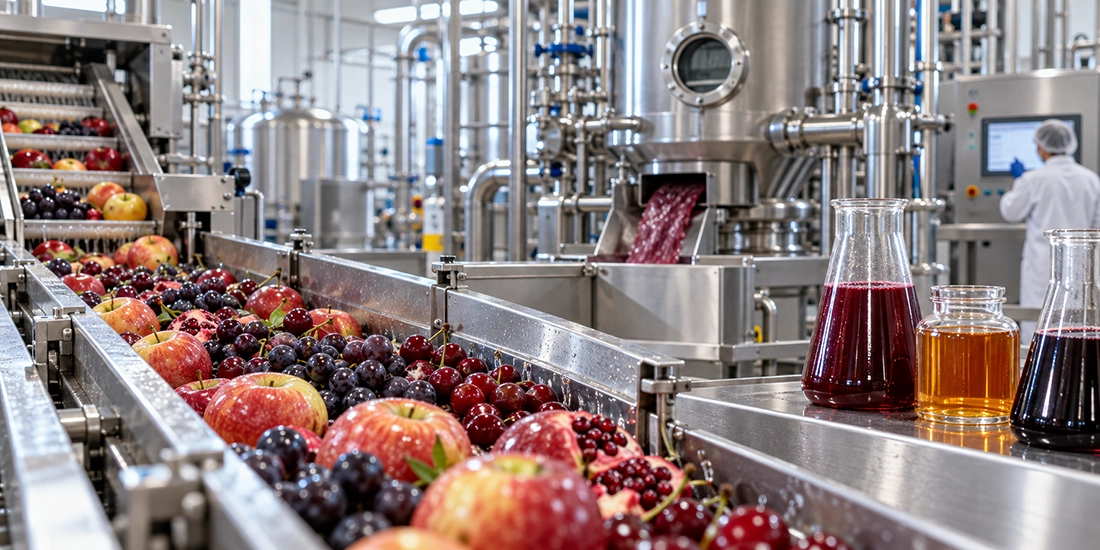
How Is Fruit Concentrate Produced?
Fruit concentrate is an important ingredient in modern food and beverage manufacturing. It is generally produced by extracting juice or other soluble components from fruit and removing a portion of the water to obtain a more concentrated product. This process reduces volume and creates an ingredient suitable for a wide range of food applications.
Understanding the production process helps manufacturers and buyers evaluate product quality and select suitable fruit concentrates.
1. Fruit Selection and Inspection
The production process begins with selecting suitable raw materials. Fruits are inspected for ripeness, physical condition, and quality before entering the processing line.
The characteristics of the raw fruit can directly influence the concentrate’s flavor, acidity, color, and soluble solids content.
2. Washing and Preparation
After inspection, the fruits are washed to remove dirt and unwanted surface materials.
Depending on the fruit variety, preparation may include sorting, crushing, peeling, destoning, or other operations to prepare the raw material for extraction.
Proper preparation helps improve processing efficiency and supports consistent product quality.
3. Juice Extraction
During this stage, juice is separated from the prepared fruit using suitable processing equipment.
Pressing is commonly used for fruits such as apples and grapes, while other fruits may require different extraction methods.
The resulting juice can contain suspended particles that require additional processing.
4. Filtration and Clarification
Depending on the required concentrate specifications, the extracted juice may undergo filtration or clarification.
These processes remove selected suspended materials and help achieve the desired appearance and consistency.
Some products retain more natural fruit particles, while others require a clearer final concentrate.
5. Concentration Process
Concentration is one of the most important production stages.
Industrial evaporators are commonly used to remove water from fruit juice. Vacuum evaporation allows water to evaporate at lower temperatures than under normal atmospheric pressure.
Temperature, pressure, and processing time must be controlled carefully to limit undesirable changes in flavor, color, and nutritional characteristics.
6. Quality Control and Packaging
The final concentrate undergoes quality checks that may include Brix measurement, acidity analysis, microbiological testing, and sensory evaluation.
After meeting the required specifications, the concentrate is packaged in suitable containers under appropriate hygienic conditions.
Packaging and storage requirements depend on the product and processing method.
Conclusion
Fruit concentrate production involves several interconnected stages, from raw material selection to packaging. Each stage contributes to the characteristics and consistency of the finished product.
Careful processing and effective quality control help manufacturers produce concentrates suitable for different food and beverage applications.
No comment